
Qubit curiosity

Having heard about the coming ‘Quantum Computing’ revolution for a couple of years now, I’ve been really curious. And while a lot of the talk has been about its application to finance, protein folding, or cryptography, my curiosity is more basic in nature. This is the first time we’ve attempted to really test Quantum Mechanics as a set of principles in the macroscopic environment. Admittedly, we’ve seen quantum effects for decades in the sub-atomic scale, but now we’re talking about capturing these effects in the ‘real world’. Does it actually work? Is quantum computing even a real thing? Given how complicated it is, should I invest the time to learn more about it if it’s only ever going to be a fringe curiosity? The more such questions I ponder, the more curious I get. So what is quantum computing, and is it going to replace our traditional computers? From what I understand, the answer is No.

Traditional computations are performed by traditional semiconductor chips that follow Moore’s Law. Now the limitations of Moore’s law itself leads us down a different line of inquiry. Transistor density is close to the limit beyond which quantum effects start to play a factor in the way the gates operate, and it is widely believed that we can’t pack much more in without losing efficacy. But that’s a discussion for another day.

People working on quantum computers have embarked on the monumental task of capturing stable quantum effects in near-zero Kelvin temperatures, with minimal error. And this hasn’t been done to any practical extent yet (we’re at roughly 50 unstable, error-ridden qubits at the moment). So, it may be premature to think about what we can do once such a computer is built and optimized for relatively widespread use.

If we want to indulge in such fantastical thinking (and indulge we shall), then quantum computers could have really cool applications. The fact that quantum computers allow for massive-scale parallel computation (actually, more like probabilistic computations in many parallel universes) lends itself to a class of problems that are intractable to a point of being impossible at the moment. The exponential nature of qubits means that 300 bits (representing a small chunk of data) can be replaced by 300 qubits which represent 2^300 bits of information – a staggering number by any account. So, cryptographic problems, protein folding configurations, and massive-scale optimization and simulations are among the applications that seem to lend themselves more naturally to quantum computers since these are considered practically unsolvable by traditional computers. What else though? I am particularly interested in the intersection between complexity theory (emergent phenomena) and quantum computing. Intuitively, there seems to be an opportunity for a breakthrough here.

It also opens the doors to a whole new way of thinking about information, and by extension, a whole new category of programming skill. Quantum thinking doesn’t come naturally to us, and there are few (if any) intuitive connections that we can reliably draw from classical physics to quantum physics. So, it seems reasonable to expect that programming quantum computers will emerge as a whole new skill.

Ref: Probably the best layperson’s introduction to the topic I’ve found is at Veritasium

What we don’t know about… Telomeres

If you want to live longer, take good care of your telomeres
– Washington Post, 13 January 2017

Molecular biologist Elizabeth Blackburn won the Nobel Prize in 2009 for the discovery of Telomerase, an enzyme made of protein and RNA subunits that elongates chromosomes by appending sequences of bases Adenine (A), Guanine (G), Cytosine (C), and Thymine (T).

Now, a telomere is a DNA sequence at the tip of a chromosome. It’s commonly described as a sort of aglet, that little plastic sheath at the end of a shoelace. These ‘sheaths’, formed of repeating sequences of DNA that can be as long as 15000 base pairs, protect the chromosomes by preventing the base pairs at the end from unraveling. As cells age, these telomeres get shorter and shorter until eventually, new cells stop replacing old ones.
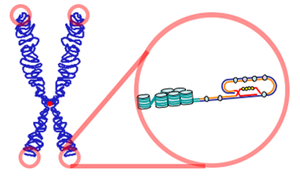
Telomere image courtesy commons.wikimedia.org

So telomerase, by elongating the telomeres, effectively slows down the shortening of telomeres as a result of natural ageing, and is fancied as a way to alter ageing at a cellular level. Telomerase is not usually active most somatic cells (cells of the body), but it’s active in germ cells (the cells that make sperm and eggs) and some adult stem cells.

Can telomeres really be lengthened?

In her book, The Telomere Effect: A Revolutionary Approach to Living Younger, Healthier, Longer, Elizabeth Blackburn suggests suggests that lifestyle choices are affect telomeres and consequently, how we age. But this view isn’t unanimous. While a variety of studies have shown that increased (moderate) activity, a mediterranean diet and getting sufficient sleep are linked to increased telomerase activity, all these studies are short-term studies and have been fairly limited in their scope and rigour.

Elizabeth’s co-author on the book, Elissa Epel, acknowledges that it’s unclear how specific lifestyle changes lengthen telomeres, and what effects this has on ageing in the long run. So far, only correlation has been shown rather than causation.

Contrary to its role in the robust propagation of regular cells, telomerase may also have a dark side. Cancer cells often have shortened telomeres, and telomerase is believed to suppress the shortening of the telomeres, thereby aiding the reproduction of these cells . If telomerase can be inhibited, this rapid division of the cancerous cells could be arrested.

So what don’t we know about telomeres?

A whole lot, to be honest. We aren’t sure there’s any causal link between telomere length and its effect on ageing. We also don’t know how exactly to regulate telomerase in cancer therapy. Just last month, scientists in Singapore announced that they may have discovered a protein ZBTB48 (the fourth known such protein after TRF1, TRF2, and HOT1) that regulates both telomeres and mitochondrial cells. There is still much to be understood about what goes on at the molecular level, and how effective the protein is in various cancers.

Sources:
2. http://embor.embopress.org/content/18/6/929
3. https://cspinet.org/tip/can-you-lengthen-your-telomeres-live-longer